Axel B. Gravem was a lawyer in Washington, DC, in 1934. My grandfather (Wilmer N. Glasscock) said Axel was "a junior member of the law firm of Tilson, Frodel, Stanley and McCuen, having offices in the Shoreham Building." He goes on to say, "We found Mr. Gravem to be a Native Son of California. He has been in Washington two and one-half years, the first year and a half with the legal department of the RFC, but the past year in private practice. He is young, lean, keen and frank." See the whole paragraph in my grandfather's book.
Contents below the pictures:
Ian Chisholm, a grandson of Axel B. Gravem, has shared two pictures for this site:
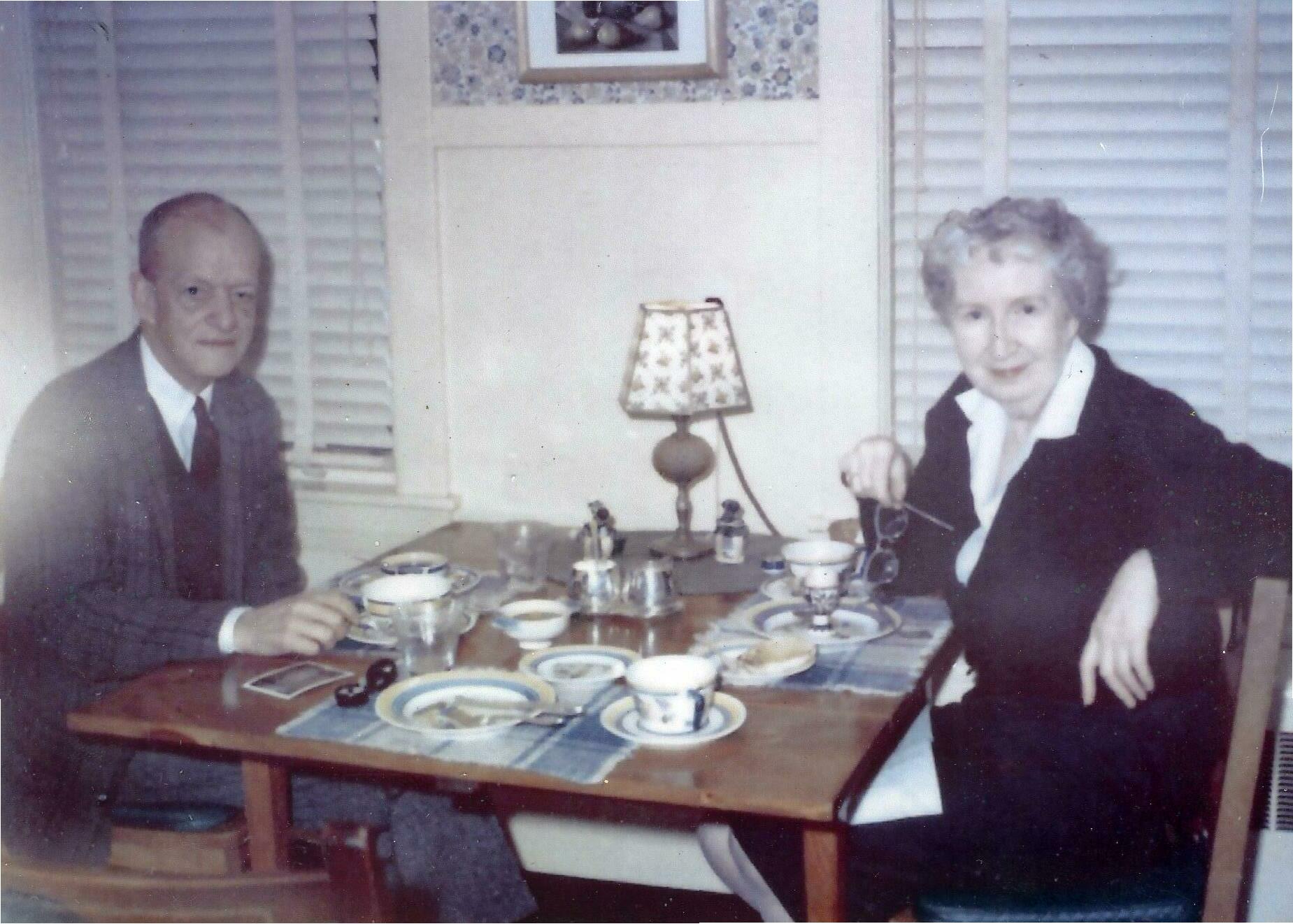
Axel and Joyce (Buchanan) Gravem
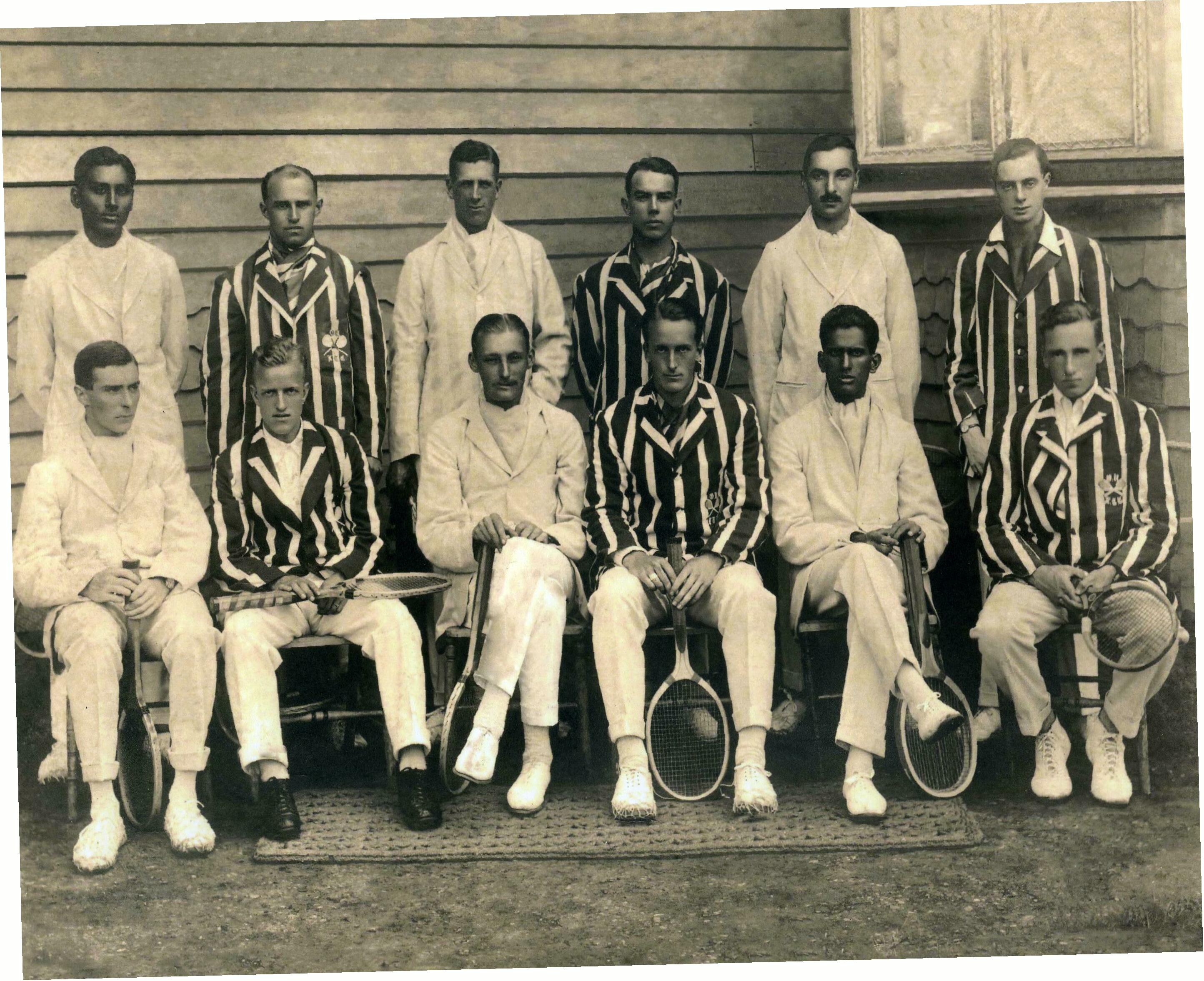
Axel Gravem in the front row with the black shoes. "Bertie" is standing on the far right.
Note: Bertie was some time after this picture crowned
King George VI.
Bertie was also the subject of the Academy-Award-winning movie
The King's Speech.
Notes and Comment From the National Capital
Copied from The Literary Digest, February 16, 1935
Axel B. Gravem, a Breezy Californian Who Became a Friend of the British Royal
Family
When He Was a Rhodes Scholar, Testifies Before Senate Munitions Inquiry.
The Senate Munitions Investigating Committee did not realize that it was grilling a friend of the British Royal Family when it had Axel B. Gravem before it last week as a witness. It probably has still to hear of his fairy-tale experience when he was a Rhodes Scholar at Oxford [University] ten years ago.
Gravem, a slight, blond student with a sunny disposition and unfailing optimism, went to Oxford from the University of California [at Berkeley]. At the time he was a crack tennis-player, in fact one of the twenty best amateurs in the United States. He made the Oxford University tennis-team at once, remaining a member of it during his three years as a Rhodes Scholar and winding up as president (captain) of it.
The team became celebrated for its prowess and was in great demand for matches not only throughout the British Isles but also on the European continent. Gravem, its star player, was taken up by English society. Week-ends became to him a succession of house-parties.
Duke’s Tennis-Mentor
The Prince of Wales mentioned here was King Edward VIII from January to December of 1936.
On one of these week-ends in the country, soon after he reached England, the young Californian fell in with the younger members of the Royal Family. The Duke of York was taking a fancy to tennis. He took a liking to Gravem, and his exuberant American enthusiasm. Gravem was invited to Buckingham Palace for a week-end. Like most of the Rhodes Scholars, he had little money and made the trip to the palace in a bus. Rhodes Scholar colleagues delight to tell how the diminutive tennis-star, a suitcase in either hand, walked up the drive to the Palace, saluted the Royal guards and announced himself as a guest of the Royal Household.
A week-end of much tennis-playing with the Duke of York followed. From then on, Gravem was a frequent guest at the Palace and at Windsor Castle. In being taken up by royalty, he reached a higher social standing than any of his colleagues at Oxford.
The way he "took it" brought many a chuckle to fellow Rhodes Scholars. Far from high-hatting the others, Gravem, upon his return to classes, regaled them with stories of his experiences in select society. Some of the stories have no doubt been embellished in the retelling. Some may be apocryphal.
But Gravem himself, at a recent social gathering, brought down the house with a narrative of the informality with which he made himself at home in the Royal Household. On one occasion he mentioned, he had chosen the most palatial of the Royal baths after a tennis-game and was enjoying the Royal showers, singing merrily, when the curtain parted and the Prince of Wales walked in for his bath. Gravem, no mean chooser, had picked the bath of the future King of England.
On one of his early visits to Buckingham Palace, Gravem, so the story goes, was seated on a divan at afternoon tea, balancing a teacup and saucer on one knee and a cake-plate on the other, and holding out his hand to receive a cake helping when Princess Mary entered. This was a situation which the breezy Westerner had not anticipated. There seemed to be nothing to do, as others rose, but to take the introduction sitting, with a cheery "hello" and nod.
Liked by Royalty
The Royal Family, like the Oxford students, liked him. Colleagues tell of the Royal limousine rolling up to the Wimbledon Courts’ entrance one morning and a crowd gathering for a glimpse of the Queen or the Prince of Wales or the Duke of York, only to be confronted by Gravem, sitting alone on the back seat and wearing a broad grin as a liveried footman opened the door and helped him to the door with his tennis-trappings.
On one occasion, after Gravem had been coaching the Duke of York at tennis for some time, the two were playing doubles and paired together at Wimbledon. Several members of the Royal Family, including Queen Mary, were looking on from the side-lines. The game got rather hot. The Duke seemed to be cutting across Gravem’s side as he ran up to the net. Onlookers were amazed to hear Axel, in exasperation, cry out, "Get back there; confound you. You’re crabbing my game!" The Duke meekly "got back."
Gravem came to Washington about two years ago and became a comparatively obscure member of the legal staff of the RFC. Previously while traveling in South America he had a chance reunion with the Prince of Wales. Needless to say the Prince remembered him well.
"Fixing" Is Denied
The Senate committee investigating the munitions industry summoned Gravem before it on the basis of testimony by Laurence R. Wilder, Chairman of the Board of the Gulf Industries, of Pensacola, Florida. Wilder had testified that Gravem, after leaving the RFC to practice law in Washington, had told him that for $250,000 he could get a "fixer" to arrange for him to get some naval business. Gravem indignantly denied the story told by Wilder and two of Wilder’s associates.
When asked whether he had mentioned $250,000 as a fee for the service of a "fixer," Gravem said the most he had done was to suggest that one Arthur P. Homer, a naval architect, might assist the firm in preparing bids and specifications to compete effectively for naval contracts.
Homer, according to the testimony, described himself as an old acquaintance of President Roosevelt. In 1932 he solicited contributions for the Roosevelt campaign from ship-builders, but his efforts were repudiated as unauthorized by James A. Farley, Democratic National Chairman.
F. W. Larouche, an investigator for the committee, said that Homer had told him that he had been "peddling paint in New York at $25 a week" prior to Mr. Roosevelt’s inauguration, but that he then came to Washington. Larouche produced what he said were memoranda from Mr. Homer’s files describing the steps by which the Navy Department was led to reconsider an informal rejection of bids for destroyer construction from a shipbuilding company at Bath, Maine.
-- DIOGENES.
Brief biographical sketch of Axel B. Gravem
(at Lambda Chi’s Rhodes Scholars, [Cross & Crescent, Lambda Chi Alpha Fraternity, April 2008, page 10]) traces his career:Axel B. Gravem (California-Berkeley 1917) studied law at Oxford, but before studying abroad, he was a lieutenant in the U.S. Expeditionary Forces from 1917-1918. Upon returning from Oxford, Gravem practiced law in Chicago while teaching at Northwestern University. He then moved his practice to the East Coast, where he owned law offices in Boston, New York City, and Washington, D.C. During World War II, Gravem was the executive vice president and director of a war plant that produced airplane parts and bullet dies. Following the war, he was president of Fairhaven Estates Corp. from 1946-1949, and was president of Lexa Oil Corp. until his retirement. He died March 1, 1985. [Note: Ian Chisholm, grandson of Axel B. Gravem, states that Axel died in 1983 in Concord, New Hampshire.]
Other References
• The Social Security Death Index (SSDI) lists only one Axel Gravem. Note that the death date agrees with information from his grandson, Ian Chisholm:
Name Birth Death Age Last Address of Record Last Benefit Issued by GRAVEM, AXEL 29 Nov 1895 Sep 1983 87 02653 (Orleans, Barnstable, MA) none specified) New York
• Axel B. Gravem wrote a letter to the editor of Life magazine concerning incorrect grammar in an article written by Ernest Hemingway: LIFE - Oct 3, 1960 - Google Books Result.
Sirs:
Mr. Hemingway may be entitled to "prose license," but such phrases as
"how slow and beautiful he could work" certainly shatter all the rules about adverbs
that I ever learned, and may well raise hell in sixth-grade English classes.
Now Johnny can write "Johnny works good," or "Jenny works slow," and, with a Nobel
Prize winner as his authority, what teacher would have the right to slap him down?
Axel B. Gravem
Orleans, Mass.
• Axel B. Gravem is listed as an initial director in a 10-KSB filing of LIFE PARTNERS HOLDINGS, INC.. LIFE PARTNERS is a "leader in the "viatical settlement industry." Life Partners is the successor name to IGE, Inc., a publicly held, Massachusetts corporation that was formed in 1971, but had been dormant and without operations since 1985. On January 21, 2000, IGE, Inc. acquired LPI in a share exchange and its name was then changed to Life Partners. Prior to January 21, 2000, it was a privately-held corporation.


